🏯 Korean Folktale Series 104
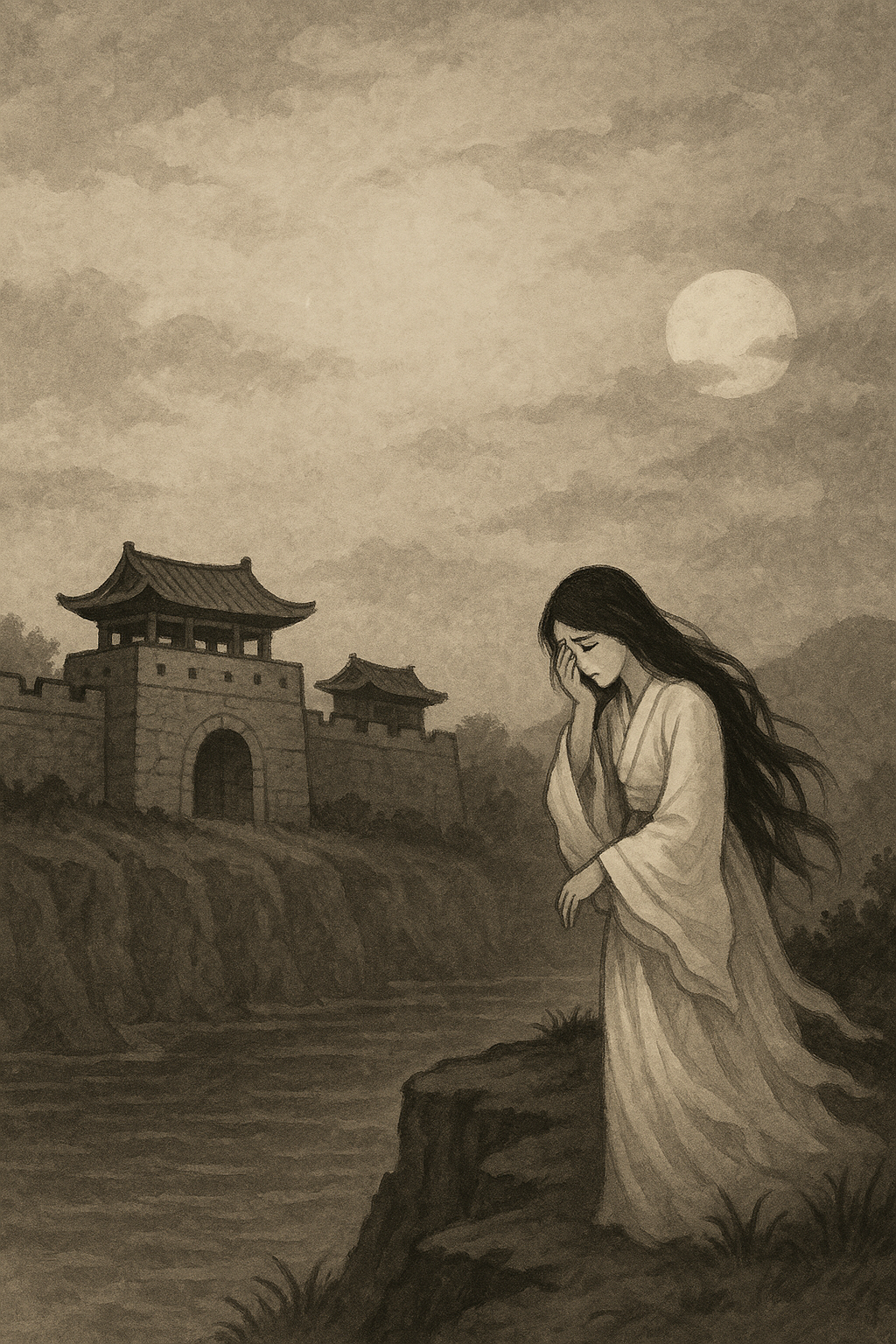
“The Ghostly Court Ladies of Sabi Fortress”
(백제 사비성의 유령 궁녀들 · Baekje Sabiseong-ui Yuryeong Gungnyeodeul)
🕰️ 1. The Story
Long ago, Sabi was the royal capital of Baekje.
Palaces stood near the river, merchants filled the streets, and music drifted through the royal halls.
But no kingdom lasts forever.
In the year 660, Baekje fell.
The palace gates were broken, familiar streets fell silent, and the people of the capital were scattered by war.
Many years later, the ruins of Sabi remained.
During the day, travelers passed through without fear.
But when the moon rose over the old palace grounds, villagers said they sometimes heard something strange.
Soft footsteps.
The rustling of silk.
And the faint sound of women whispering in the darkness.
People began calling them the ghostly court ladies of Sabi.
Some believed they were women who had once served in the royal palace and whose spirits could not leave the fallen capital.
Others said they were only the voices of the wind moving through the ruins.
Whatever the truth, few people dared to walk there alone at night.
One autumn evening, a young traveler named Do-yun arrived in Sabi.
He had spent years wandering from village to village, copying old stories and listening to the memories of elderly people.
When he heard about the mysterious women, he became curious.
That night, beneath a bright moon, Do-yun walked toward the ruins.
At first, he heard nothing.
Then came the faint sound of footsteps behind him.
He turned.
No one was there.
A moment later, several pale figures appeared beneath the trees.
They wore the graceful robes of another age.
Do-yun's heart pounded.
But instead of running away, he bowed.
“Who are you?”
One of the women stepped forward.
Her voice was as soft as falling leaves.
“We once lived inside these walls.”
Another whispered,
“We prepared lamps when darkness came.”
A third said,
“We carried water, embroidered robes, delivered messages, and waited for families we never saw again.”
Do-yun looked at them carefully.
They did not seem angry.
They seemed unbearably sad.
“Why do you remain here?” he asked.
The first woman looked toward the moonlit ruins.
“People remember kings.”
Another continued,
“They remember generals and battles.”
Then the youngest among them lowered her eyes.
“But who remembers those whose names were never written?”
Do-yun had no answer.
The women led him deeper into the ruins.
There, beneath an old tree, he saw dozens of tiny lights floating above the ground.
Each light flickered like a small palace lantern.
“These are our memories,” said one of the women.
Do-yun saw brief images within them.
A girl laughing with her sister before entering palace service.
A woman sewing a winter robe for someone she loved.
Another secretly saving a handful of rice to send home to her mother.
There were no kings in these memories.
No great battles.
Only ordinary lives.
Do-yun finally understood.
These spirits were not wandering because they wished to frighten the living.
They remained because their stories had disappeared.
He bowed deeply.
“I cannot restore your kingdom.”
He looked at the countless lights.
“And I cannot recover every name that history has forgotten.”
Then he opened the bundle of paper he carried.
“But I can remember that you lived.”
For the rest of the night, Do-yun listened.
He wrote down everything the women wished to tell—their hopes, their families, their laughter, their fears, and the final days of Sabi.
As dawn approached, the eastern sky slowly brightened.
The oldest court lady smiled.
“That is enough.”
One by one, the small lights rose into the sky.
The women began to fade with them.
Before disappearing, the youngest turned toward Do-yun.
“When you tell the story of a fallen kingdom, remember the people who stood outside the pages of history.”
Then she vanished into the morning mist.
Years later, Do-yun became an old man.
Whenever children gathered around him to hear stories of Baekje, he spoke not only of kings, warriors, and the fall of Sabi.
He also told them about the nameless people who had cooked meals, carried water, raised children, waited for loved ones, and endured the sorrow of war.
And people say that after those stories began to spread, the mysterious footsteps around the old palace became quieter.
Yet on certain autumn nights, when moonlight falls upon the ancient land of Sabi, the faint rustling of silk can still be heard.
Not as a warning.
Not as a curse.
But as a whisper from the past:
“Remember that we were here.”
🪄 2. Meaning & Lessons
▪️ History belongs not only to kings and heroes, but also to ordinary people whose names were never recorded.
▪️ Remembering those who suffered is one way of giving dignity to the past.
▪️ War destroys more than kingdoms—it changes countless individual lives.
👀 3. Reflections in Life
▪️ Behind every great historical event are ordinary people with families, dreams, and fears.
▪️ A person does not need to be famous for their life to have meaning.
▪️ Remembering the forgotten helps us see history with greater compassion.
🌏 4. Similar Tales Around the World
Japan — Spirits in Abandoned Castles
Japanese ghost traditions often connect old castles and battlefields with spirits whose memories remain tied to places of loss.
Britain — Ghosts of Ancient Castles
British folklore contains many stories of figures from the past said to wander castles where tragedy once occurred.
China — Palace Ghost Traditions
Stories surrounding old palaces sometimes portray forgotten attendants and court figures whose spirits preserve memories of vanished dynasties.
💬 A Warm Saying
“History remembers the powerful, but compassion remembers everyone.”
📌 Note
This is creative cultural content from the Misojieum Story Blog (kor-telling.com).
Please do not copy without permission. Sharing is welcome with proper source citation.
More Korean Folktales
Discover more traditional Korean stories here.
'Korean Folktales & World Folktales' 카테고리의 다른 글
| Korean Folktale : The Water Ghost of Uiam Lake (0) | 2026.09.02 |
|---|---|
| Korean Folktale : The Seven-Star Altar and the Falling Star (0) | 2026.08.22 |
| Korean Folktale : The Legend of Suguk Rock on Mudeungsan (0) | 2026.08.13 |
| Korean Folktale : The Pine Tree with a Mothers Embrace (0) | 2026.07.27 |
| Korean Folktale : The Camellia Blossoms on the Road to the Afterlife (1) | 2026.06.28 |
| Korean Folktale : The Secret Bookshop of Joseon (0) | 2026.06.07 |
| Korean Folktale : The Guardian Spirit of the Village Well (0) | 2026.05.24 |
| Korean Folktale : The Bond Created by the Magpie (0) | 2026.05.14 |