🕊️ Korean Folktale Series 105
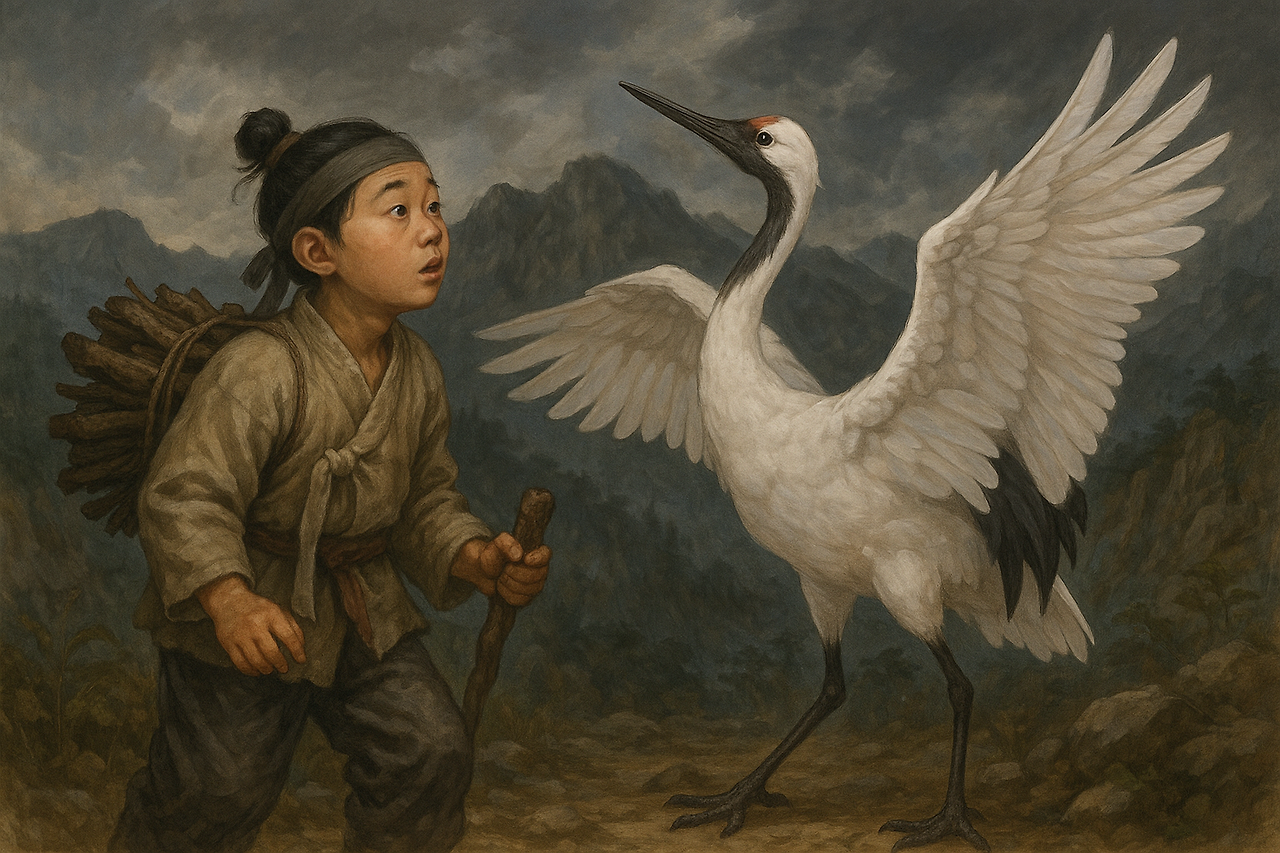
“The Crane’s Revenge on Geumosan Mountain”
(금오산 학의 복수 이야기 · Geumosan Hagui Boksu Iyagi)
🕰️ 1. The Story
Long ago, when the mountains of Korea were covered with ancient forests, a beautiful white crane lived among the rocky cliffs of Geumosan Mountain.
Its feathers were as white as winter snow, and its wings stretched gracefully across the blue sky.
The villagers believed that the crane was no ordinary bird.
They said it had lived on the mountain for many years, watching over the forests and protecting the creatures that called them home.
Whenever the crane appeared above the village, the elders would smile.
“As long as the white crane flies over Geumosan, peace will remain in our valley.”
At the foot of the mountain lived a young woodcutter named Jun-seo.
He was poor, but he had a gentle heart.
Whenever he entered the forest, he took only fallen branches and never harmed the animals.
One spring morning, Jun-seo discovered a white crane lying beside a mountain stream.
One of its wings was badly injured.
He carefully approached the frightened bird.
“Do not be afraid. I will not hurt you.”
Jun-seo carried the crane to a sheltered place and treated its wound with clean water and medicinal herbs.
For several days, he returned with food and fresh water.
Eventually, the crane recovered.
Before flying away, it bowed its long neck three times, as though expressing gratitude.
Jun-seo smiled.
“Go now. The sky is where you belong.”
The crane spread its wings and disappeared beyond the mountain peaks.
But not everyone in the village respected the creatures of Geumosan.
A wealthy hunter named Master Jang believed that everything in the forest existed for human use.
He hunted deer, trapped birds, and sold rare animals to wealthy merchants.
One day, he heard rumors of a magnificent white crane living on the mountain.
“A bird with feathers like snow must be worth a fortune!”
He gathered several hunters and climbed Geumosan.
After searching for hours, they discovered the crane standing beside a nest high among the rocks.
Inside the nest were two young chicks.
Master Jang raised his bow.
One of the hunters hesitated.
“Sir, the bird is protecting its young. Perhaps we should leave it alone.”
But Master Jang laughed.
“A bird is only a bird. What difference does it make?”
He released his arrow.
The crane cried out and rose into the air.
The arrow struck the rocks beside its nest, sending stones tumbling down the cliff.
The nest collapsed.
The two young chicks disappeared into the valley below.
A terrible silence fell over the mountain.
The white crane circled above the broken nest, calling again and again.
Its sorrowful cries echoed through the forest.
Then something strange happened.
Dark clouds gathered above Geumosan.
The wind grew cold.
The crane flew directly toward Master Jang and let out a piercing cry.
The hunters trembled.
But Master Jang only shouted,
“You cannot frighten me!”
He raised his bow once more.
Suddenly, the mountain shook beneath his feet.
A violent gust swept through the trees, and thick mist swallowed the path.
The hunters scattered in fear.
Master Jang tried to follow them, but every trail seemed to lead back to the same broken cliff.
Above him, the white crane continued circling.
Its shadow stretched across the rocks like a great spirit of the mountain.
Master Jang ran until his strength failed.
At last, he collapsed beneath an old pine tree.
Through the mist, he heard a voice.
“You took what you did not need. You destroyed what you did not understand.”
Master Jang looked around in terror.
“Who speaks to me?”
The voice answered,
“The mountain remembers every life that suffers upon it.”
Then the white crane descended onto a nearby rock.
Its eyes shone with sorrow.
For the first time, Master Jang understood that the bird before him was not merely an animal he could capture and sell.
It was a living creature that had lost its young.
He lowered his head.
“I have done something terrible.”
The crane remained silent.
Master Jang began to weep.
“I cannot undo what I have done. But if I return home, I will never hunt for greed again.”
The mist slowly began to lift.
Yet the crane did not move.
Master Jang understood that words alone could not repair the harm he had caused.
When he finally returned to the village, he broke his hunting bow.
He released the birds he had kept in cages and stopped trapping animals for profit.
He also helped the villagers protect the forests around Geumosan.
Years passed.
The mountain gradually became peaceful again.
One autumn evening, Jun-seo saw the white crane standing beside the same stream where he had once saved its life.
Its feathers glowed beneath the setting sun.
Jun-seo approached quietly.
“You have returned.”
The crane looked toward the distant cliffs.
There was sadness in its eyes, but no anger.
Jun-seo bowed his head.
“Some wounds cannot be forgotten. But perhaps peace can grow where suffering once lived.”
The crane slowly opened its wings.
It rose into the golden sky and circled above Geumosan one final time.
Then it disappeared beyond the clouds.
From that day onward, the villagers taught their children that the mountain belonged not only to humans, but to every creature living within it.
And whenever a white crane appeared above the distant peaks, the elders remembered the lesson of Geumosan.
“Nature does not seek revenge without reason. It reminds us that every life deserves respect.”
🪄 2. Meaning & Lessons
▪️ Every life deserves respect.
Animals are not merely possessions or resources for human use. They are living beings capable of suffering and loss.
▪️ Greed can destroy what cannot be replaced.
Master Jang's desire for wealth caused suffering that no amount of money could repair.
▪️ True repentance requires action.
Recognizing a mistake is important, but changing one's behavior is what gives repentance meaning.
👀 3. Reflections in Life
▪️ The consequences of our actions reach beyond ourselves.
Even a single careless decision can affect other lives and the natural world.
▪️ Compassion begins with understanding another being's suffering.
Jun-seo saw an injured creature that needed help, while Master Jang initially saw only something valuable to capture.
▪️ Protecting nature is a responsibility shared by everyone.
Forests, mountains, rivers, and wildlife are part of the world we pass on to future generations.
🌏 4. Similar Tales Around the World
Japan — Tsuru no Ongaeshi (The Grateful Crane)
In this Japanese folktale, a crane repays a human's kindness. While the Korean-inspired story of Geumosan focuses on the consequences of cruelty, both emphasize the relationship between humans and animals.
China — The Crane as a Symbol of Longevity
In Chinese cultural traditions, cranes often symbolize longevity, spiritual purity, and harmony. These associations encourage respect for the natural world.
Greece — The Cranes of Ibycus
An ancient Greek story tells of cranes connected with the revelation of a murder. Like the story of Geumosan, it explores the idea that wrongdoing cannot always remain hidden.
💬 A Warm Saying
“Those who respect even the smallest life will discover the true greatness of nature.”
📌 Note
This is creative cultural content from the Misojieum Story Blog (kor-telling.com).
Please do not copy without permission. Sharing is welcome with proper source citation.
More Korean Folktales
Discover more traditional Korean stories here.
'Korean Folktales & World Folktales' 카테고리의 다른 글
| Korean Folktale : The Ghostly Court Ladies of Sabi Fortress (0) | 2026.09.13 |
|---|---|
| Korean Folktale : The Water Ghost of Uiam Lake (0) | 2026.09.02 |
| Korean Folktale : The Seven-Star Altar and the Falling Star (0) | 2026.08.22 |
| Korean Folktale : The Legend of Suguk Rock on Mudeungsan (0) | 2026.08.13 |
| Korean Folktale : The Pine Tree with a Mothers Embrace (0) | 2026.07.27 |
| Korean Folktale : The Camellia Blossoms on the Road to the Afterlife (1) | 2026.06.28 |
| Korean Folktale : The Secret Bookshop of Joseon (0) | 2026.06.07 |
| Korean Folktale : The Guardian Spirit of the Village Well (0) | 2026.05.24 |