Stories of Korea’s National Treasures 67
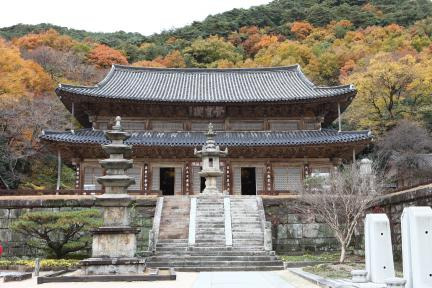
Photo Credit : Cultural Heritage Administration of Korea
Gakhwangjeon Hall of Hwaeomsa Temple
(Gurye, Jeollanam-do)
🏯 1. A Grand Hall Beneath Jirisan Mountain
At Hwaeomsa Temple, nestled along the slopes of Jirisan Mountain, stands the majestic Gakhwangjeon Hall — one of the largest and most magnificent Buddhist halls in Korea.
Originally founded during the Unified Silla period and later reconstructed in the Joseon Dynasty (18th century), the hall reflects the enduring vitality of Korean Buddhism through centuries of change.
The name Gakhwangjeon means “Hall of Enlightened Kings,” symbolizing a sacred space where wisdom and compassion illuminate the world like radiant light.
🪨 2. Architectural Grandeur and Balance
Gakhwangjeon is celebrated for its imposing scale and refined structural harmony.
The building features a broad rectangular layout supported by massive wooden pillars and an elegant multi-bracket roof system (dapo style) characteristic of late Joseon architecture.
Its roof stretches outward in graceful curves, creating a feeling of stability and openness at once.
Despite its size, the hall never feels heavy; instead, its proportions guide the eye naturally upward toward the sky.
Inside, the vast interior space is filled with towering Buddha statues, painted details, and softly filtered light, producing an atmosphere of solemn calm.
Every beam and bracket reveals the extraordinary craftsmanship of Korean carpenters who balanced engineering precision with spiritual aesthetics.
🌄 3. The Spirit of Hwaeom Philosophy
Hwaeomsa Temple is deeply connected to Hwaeom Buddhism, a tradition emphasizing the interconnection of all things in the universe.
Gakhwangjeon embodies this philosophy architecturally.
Its countless interlocking wooden elements support one another in perfect balance, symbolizing a world where every being is connected through harmony and mutual existence.
Standing inside the hall, one feels not isolation, but inclusion —
as though every pillar, beam, and breath belongs to a greater whole.
The hall teaches quietly that enlightenment is not separation from the world,
but understanding one’s place within it.
🌿 4. Preservation and Cultural Legacy
The Gakhwangjeon Hall of Hwaeomsa Temple remains one of the finest surviving examples of large-scale Joseon Buddhist architecture.
Its structural sophistication and spiritual atmosphere continue to inspire scholars, monks, and visitors alike.
Designated National Treasure No. 68, the hall stands as a living testament to Korea’s architectural mastery and enduring Buddhist heritage.
Even after centuries of wind, rain, and history,
its wooden framework still holds firm —
like wisdom preserved through generations.
💬 5. A Warm Reflection
“This hall stands through balance, not force.
Each beam depends on another, each space opens into the next.
And perhaps wisdom, too, is learning how deeply we belong to one another.”
📌 Notice
The National Treasure number indicates the order of designation, not a ranking of value.
For more information, please visit the 👉 National Heritage Portal.
More Stories of Korea’s National Treasures
Discover more national treasures of Korea here.