🌾 Korean Traditional Game 75
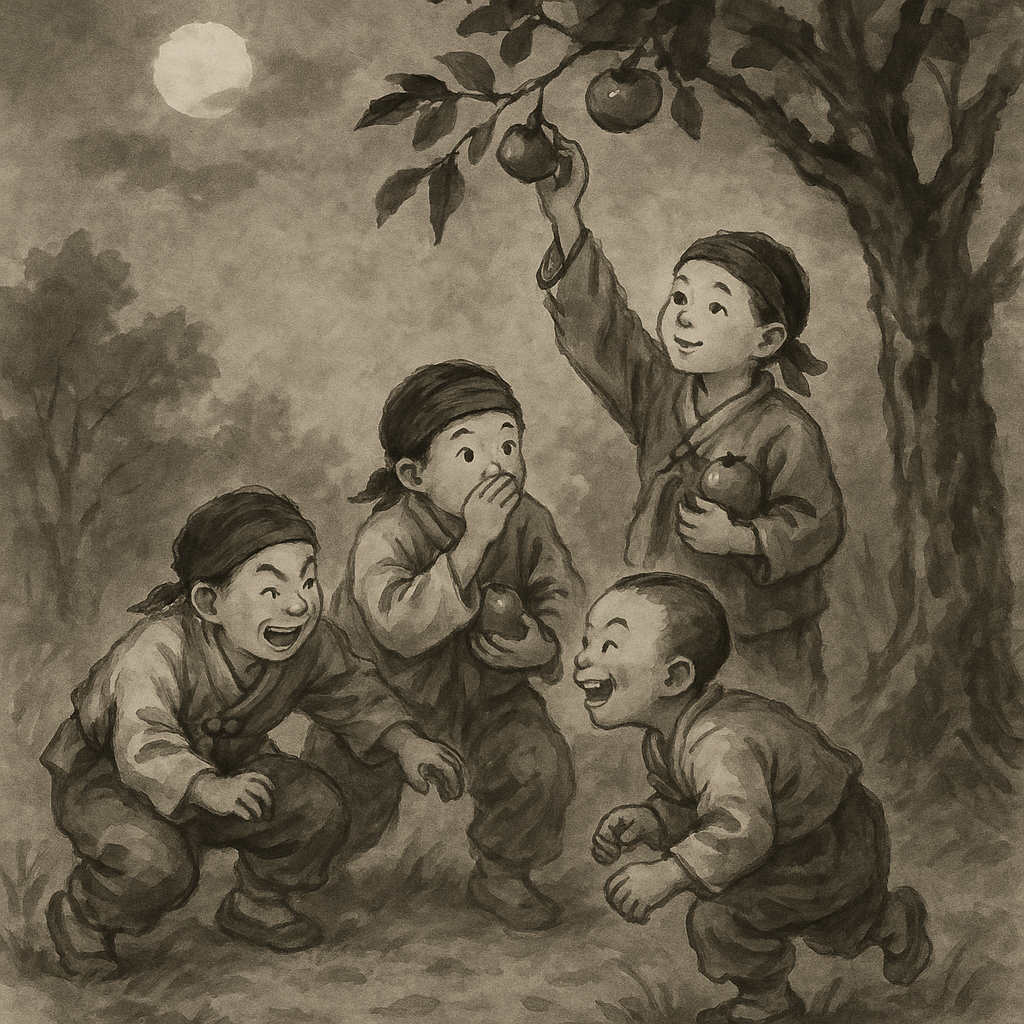
Seori Nori
(서리놀이 · Traditional Korean Harvest Mischief)
🕰️ 1. The Game
Seori Nori (서리놀이) refers to a mischievous activity associated with traditional Korean rural life, in which children or young people secretly took small amounts of crops from fields and sometimes cooked and shared them with friends.
In the past, Korean farming villages were surrounded by fields of sweet potatoes, potatoes, corn, and other seasonal crops.
During harvest time, children sometimes slipped into nearby fields to take a few crops, later gathering around a small fire to roast and eat them together.
Unlike organized traditional games with fixed rules, Seori Nori was more of a mischievous rural pastime.
Although such behavior could be treated as playful mischief in some village settings, taking another person's crops without permission was still wrong and could cause real harm to farmers.
Today, Seori Nori is best understood as part of the memories and social history of traditional Korean village life.
🪄 2. How It Was Enjoyed
Seori Nori did not have official rules like most traditional games.
A typical scene might involve:
- A group of children gathering near farmland
- Choosing crops such as sweet potatoes, potatoes, or corn
- Secretly entering a field and taking a small amount
- Running away together without being noticed
- Roasting or cooking the crops
- Sharing the food while telling stories and laughing
👉 The excitement came from secrecy, adventure, and sharing food with friends.
However, taking crops without the owner's permission was not an acceptable practice, even when children regarded it as a game.
Today, similar outdoor experiences can be enjoyed through permitted harvest activities and shared cooking.
👀 3. A Scene from Life
The autumn sun slowly disappears behind the mountains.
A group of village children gathers beside a narrow country road.
Beyond the road lies a sweet potato field, its green vines stretching across the soil.
One child whispers,
"Are you sure nobody is watching?"
The others exchange nervous smiles.
After a moment of hesitation, they hurry into the field.
Soon, the children return with a few sweet potatoes and gather around a small fire.
As the sweet potatoes roast, a warm, earthy smell fills the evening air.
One child breaks open a roasted sweet potato, revealing its soft golden center.
Everyone reaches forward eagerly.
Their laughter echoes through the quiet countryside.
For the children, the adventure becomes an unforgettable memory.
For the farmer, however, the missing crops represent the results of hard work.
This contrast reminds us that childhood memories can contain both innocent excitement and important lessons about respecting others.
🌏 4. Similar Traditions Around the World
Japan: Rural childhood stories sometimes describe mischievous adventures involving fruit trees and farm produce.
Europe: Traditional village stories include accounts of children secretly taking fruit from orchards.
North America: Rural childhood memories sometimes feature unauthorized fruit picking and outdoor cooking adventures.
Around the world: Children have often turned fields, orchards, and natural surroundings into places of adventure and exploration.
✨ Seori Nori reflects a familiar part of childhood history: the desire for adventure, the excitement of sharing food, and the need to learn respect for other people's belongings.
💌 Closing Words
Seori Nori is more than a story about children secretly taking crops.
It offers a glimpse into the everyday lives of children growing up in traditional Korean farming villages.
The fields were their surroundings, the changing seasons shaped their activities, and friendships were often strengthened through shared experiences.
Yet the story also carries an important lesson.
What seems like harmless fun to one person may represent a loss to someone else.
The sweetest memories are those that bring happiness without causing harm.
Today, we can preserve the spirit of friendship, adventure, and sharing while respecting the people whose hard work brings food to our tables.
Sometimes, understanding an old tradition means appreciating its memories while learning from its mistakes.
📌 Note
This is creative cultural content from the Misojieum Story Blog (kor-telling.com).
The scene described above is a fictional illustration inspired by traditional Korean rural life.
Please do not copy without permission. Sharing is welcome with proper source citation.
Explore more traditional Korean games and folk play here.
'Korean Traditional Games' 카테고리의 다른 글
| Korean Traditional Game : Chilgyo Nori (0) | 2026.09.12 |
|---|---|
| Korean Traditional Game : Sugeon Dolligi (0) | 2026.08.31 |
| Korean Traditional Game : Jusawi Nori (1) | 2026.08.20 |
| Korean Traditional Game : Julneomgi (0) | 2026.08.10 |
| Korean Traditional Game : Hwatu Nori (0) | 2026.07.19 |
| Korean Traditional Game : Jangchigi (0) | 2026.06.21 |
| Korean Traditional Game : Gilsam Nori (0) | 2026.06.01 |
| Korean Traditional Game : Jebibbopgi (0) | 2026.05.22 |