Korean Traditional Game 70
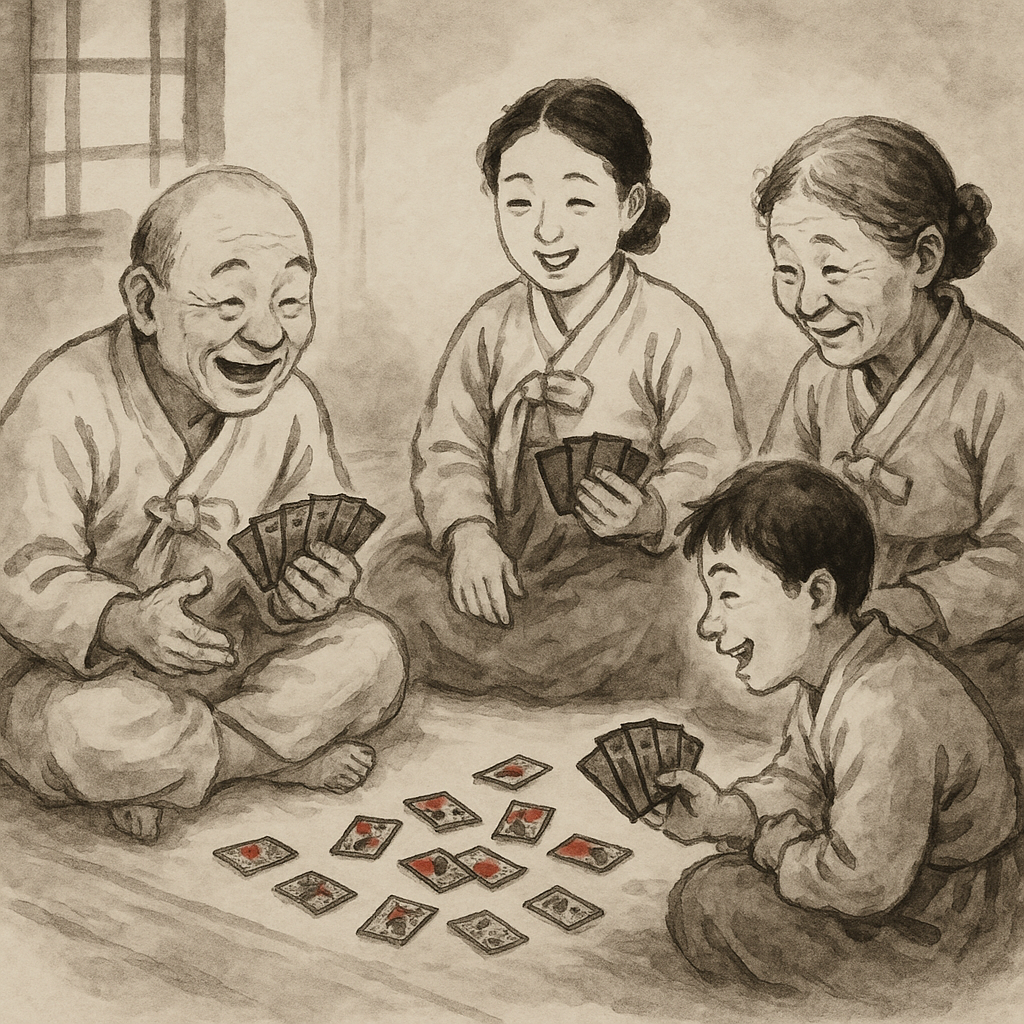
(화투놀이 · Korean Flower Card Game)
🕰️ 1. The Game
Hwatu Nori (화투놀이) is a traditional Korean card game played with a colorful deck of flower cards known as Hwatu.
The cards feature illustrations representing the twelve months of the year, with flowers, animals, ribbons, and seasonal symbols.
Over time, Koreans developed a variety of games using Hwatu cards, the most well-known being Go-Stop (고스톱).
Families and friends often gathered to enjoy Hwatu during holidays, festivals, and family reunions, making it one of Korea's most recognizable traditional tabletop games.
Today, while some versions involve gambling, the traditional family form of Hwatu is enjoyed simply as a game of strategy, memory, and entertainment.
🪄 2. How to Play
A deck of Hwatu cards is shuffled and dealt
Players collect matching cards based on the month or card type
Special combinations earn additional points
Players decide whether to continue the round or end the game, depending on the rules
The player with the highest score wins
👉 The game rewards observation, memory, strategy, and careful decision-making.
👀 3. A Scene from Life
During the Lunar New Year holiday, three generations gather around a warm table.
Grandparents carefully shuffle the colorful flower cards while children eagerly watch each turn.
Laughter fills the room whenever someone completes a valuable combination, and playful conversations continue between every round.
Outside, the winter wind blows quietly, but inside the home, the bright cards and smiling faces create a joyful atmosphere of family togetherness.
🌏 4. Similar Games Around the World
Japan: Hanafuda, the original flower-card deck that inspired Hwatu
China: Traditional matching card games based on symbolic designs
Western countries: Rummy and other set-collecting card games
✨ Hwatu Nori illustrates how beautifully designed cards can bring generations together through friendly competition and shared traditions.
💌 Closing Words
Hwatu Nori is more than a card game.
It reflects Korea's appreciation for seasonal beauty, family gatherings, and thoughtful strategy.
For many people, the colorful flower cards also bring memories of holidays spent with parents, grandparents, and lifelong friends.
Although modern entertainment has changed over time, Hwatu continues to connect generations through conversation, laughter, and tradition.
📌 Note
This is a creative cultural content from the Misojieum Story Blog (kor-telling.com).
Please do not copy without permission. Sharing is welcome with proper source citation.
More Korean Traditional Games
Explore more traditional Korean games and folk play here.
'Korean Traditional Games' 카테고리의 다른 글
| Korean Traditional Game : Chilgyo Nori (0) | 2026.09.12 |
|---|---|
| Korean Traditional Game : Sugeon Dolligi (0) | 2026.08.31 |
| Korean Traditional Game : Jusawi Nori (1) | 2026.08.20 |
| Korean Traditional Game : Julneomgi (0) | 2026.08.10 |
| Korean Traditional Game : Jangchigi (0) | 2026.06.21 |
| Korean Traditional Game : Gilsam Nori (0) | 2026.06.01 |
| Korean Traditional Game : Jebibbopgi (0) | 2026.05.22 |
| Korean Traditional Game : Donchigi (0) | 2026.05.12 |