🦗 Korean Traditional Game Series 60
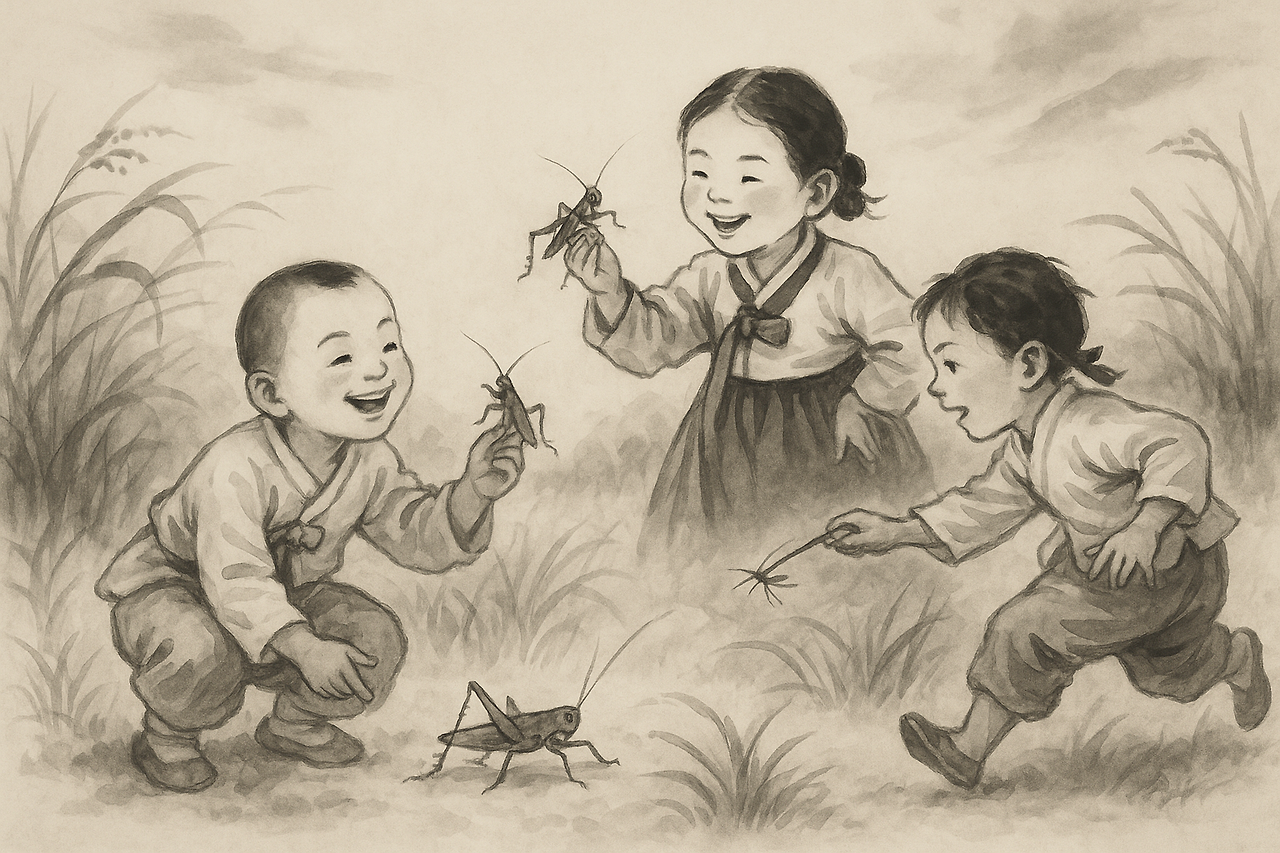
Bangaekkaebi Nori
(방아깨비놀이 · Korean Grasshopper Play)
🕰️ 1. Introduction
Bangaekkaebi Nori (방아깨비놀이) is a lively Korean traditional children’s game inspired by the bangaekkaebi—the grasshopper.
In rural Korea, children often played in fields and rice paddies where grasshoppers leapt energetically among crops. Their springing movement became the model for a playful jumping game that combined agility, laughter, and imitation of nature.
The name “bangaekkaebi” is linked to the word bangatdol (millstone) because the insect’s posture resembles a pounding motion. In play, children mimicked these lively jumps, celebrating the rhythms of the countryside.
🪄 2. How to Play
- Choosing the “grasshoppers”:
All players crouch low, bending their knees and placing their hands lightly on the ground, preparing to jump like grasshoppers. - Jumping forward:
On a signal, everyone hops forward together without standing upright. The goal is to maintain balance and rhythm while moving ahead. - Friendly challenges:
Players may compete to see who can jump the farthest or last the longest without falling.
If someone stands up or loses balance, laughter erupts and the round restarts. - Imitating nature:
Sometimes children make chirping sounds or pretend to hide in “grass” to add imagination to the game.
Bangaekkaebi Nori encourages leg strength, coordination, and resilience—while keeping the mood light and joyful.
👀 3. Example from Life
In a golden rice field after harvest, children line up in the open yard.
“Ready, grasshoppers?” one shouts.
They crouch and spring forward—hop, hop, hop—trying not to topple over.
Soon, giggles fill the air as someone tumbles gently into the straw.
Under the wide sky, the game becomes a celebration of movement and nature’s energy.
🌏 4. Similar Traditions Around the World
- China: Animal imitation games where children mimic insects and birds.
- India: Frog-jump races played in schoolyards and fields.
- Europe: Bunny-hop and leapfrog-style games emphasizing balance and agility.
Across cultures, children have always learned through imitation—copying animals and nature to build strength and joy.
💌 Closing Words
Bangaekkaebi Nori reminds us that play begins with observation.
By watching the small creatures of the field, children turned simple movements into shared laughter and growth.
It teaches that energy, resilience, and happiness can spring from the smallest inspirations—just like a grasshopper leaping into the sunlight.
📌 Note
This is a creative cultural content from the Misojieum Story Blog (kor-telling.com).
Please do not copy without permission. Sharing is welcome with proper source citation.
Explore more traditional Korean games and folk play here.
'Korean Traditional Games' 카테고리의 다른 글
| Korean Traditional Game : Guseulchigi (0) | 2026.04.23 |
|---|---|
| Korean Traditional Game : Dwaeji Molli Nori (0) | 2026.04.07 |
| Korean Traditional Game : Dukkebi-jip Jitgi (0) | 2026.03.20 |
| Korean Traditional Game : kot Chajgi Nori (0) | 2026.03.08 |
| Korean Traditional Game : Maetdol Nori (0) | 2026.02.09 |
| Korean Traditional Game : Didilbanga Nori (0) | 2026.01.27 |
| Korean Traditional Game : Tujeon (0) | 2026.01.19 |
| Korean Traditional Game : Sogup Nori (0) | 2026.01.12 |