Korean Proverb Series 89
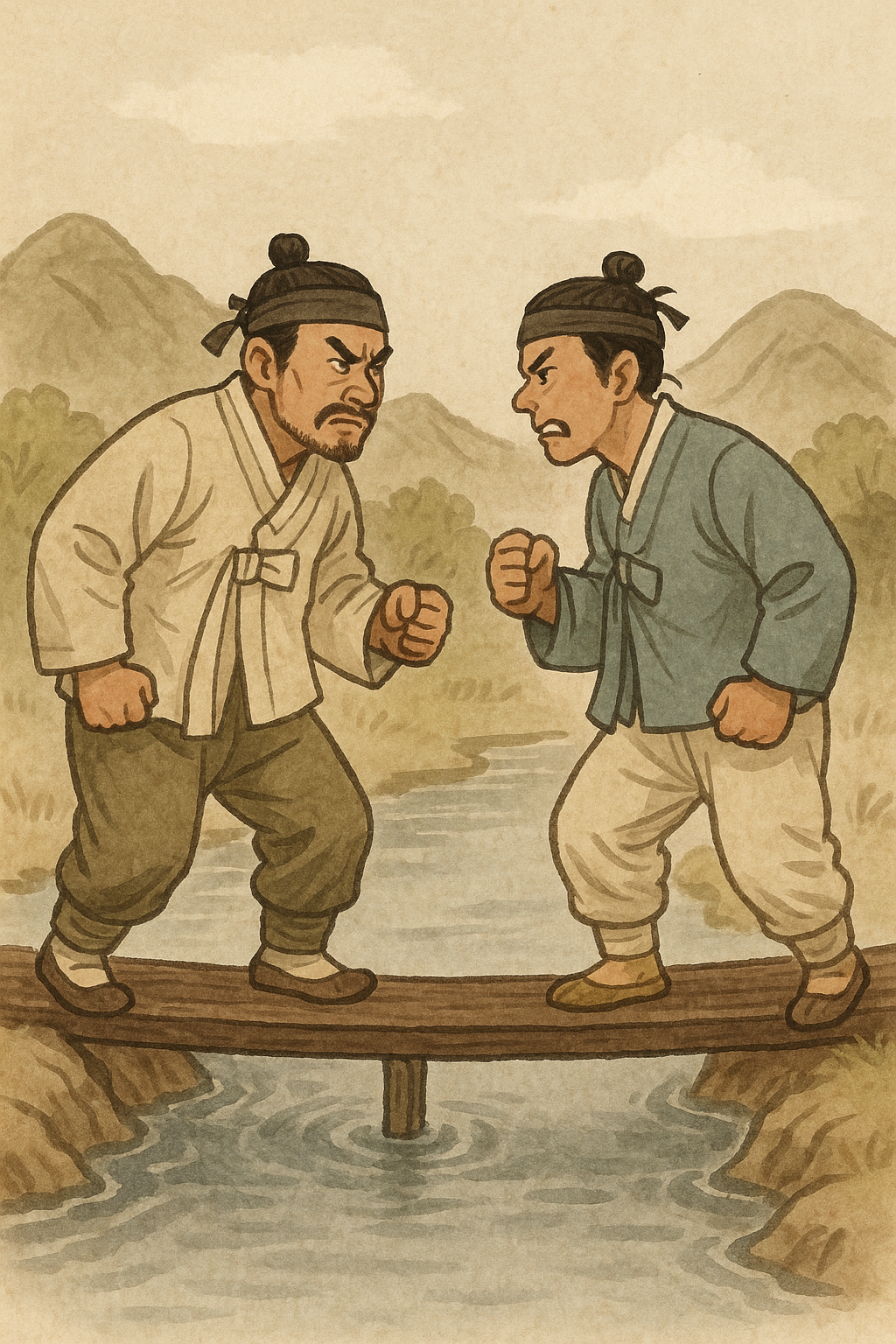
Enemies Meet on a Narrow Bridge
“원수는 외나무다리에서 만난다”
(Wonsu-neun oenamudari-eseo mannanda)
🕰️ 1. The Proverb’s Core Meaning
The Korean proverb “원수는 외나무다리에서 만난다” literally means
“Enemies meet on a narrow wooden bridge.”
It expresses the idea that even if you try to avoid someone you dislike,
fate may eventually bring you face to face —
often in a situation where neither can escape.
A narrow bridge symbolizes a place where confrontation is unavoidable.
This proverb teaches that unresolved conflicts
have a way of returning at unexpected moments.
🪄 2. Meaning & Key Lesson
▪️ Avoidance does not erase conflict.
▪️ Fate often forces unfinished matters to resurface.
▪️ It is wiser to resolve issues than to run from them.
The proverb suggests that
life has a way of bringing unfinished business back to us.
👀 3. Real-Life Applications
▪️ Someone who avoids addressing workplace tension
later faces a direct confrontation.
▪️ A broken friendship left unresolved
reappears in social or professional settings.
▪️ Ignoring responsibility today
may create unavoidable consequences tomorrow.
This saying reminds us that
courage in resolution prevents future collisions.
🌏 4. Similar Proverbs Around the World
▪️ United States — “What goes around comes around.”
→ Actions and unresolved matters return.
▪️ United Kingdom — “You can’t avoid someone forever.”
→ Fate eventually brings people together.
▪️ China — “冤家路窄 (Yuān jiā lù zhǎi).”
→ Enemies meet on a narrow road.
▪️ Japan — “因縁浅からず (In’en asakarazu).”
→ Certain encounters are destined and unavoidable.
Across cultures, people understand that life often arranges inevitable meetings.
💬 A Warm Saying
“If you must cross the bridge someday, walk it with courage rather than fear.”
📌 Note
This is a creative cultural content from the Misojieum Story Blog (kor-telling.com).
Please do not copy without permission. Sharing is welcome with proper source citation.
Explore more traditional Korean sayings here.
'Korean Proverbs & World Proverbs' 카테고리의 다른 글
| Korean Proverb : A Drop of Blood on a Birds Foot (0) | 2026.04.10 |
|---|---|
| Korean Proverb : Playing Both the Drum and the Gong Alone (0) | 2026.03.31 |
| Korean Proverb : Whipping a Running Horse (0) | 2026.03.22 |
| Korean Proverb : If Things Go Wrong People Blame Their Ancestors (0) | 2026.03.12 |
| Korean Proverb : Even a Mouse Hole Has Its Day of Sunshine (0) | 2026.02.12 |
| Korean Proverb : Where Theres Smoke Theres Fire (0) | 2026.01.29 |
| Korean Proverb : Covering Ones Eyes and Saying Awoong (0) | 2026.01.21 |
| Korean Proverb : Using a Cow-Killing Knife to Catch a Chicken (0) | 2026.01.14 |